ServicesWater softeners
Water Softeners in Sunnyvale That Start With a Test
Softeners cost real money and take up space, so we measure your water before recommending one. When the hardness numbers justify it, we size a unit to your home and install it. When they don't, you hear that from us directly, along with what would help instead.
Test first, then decide
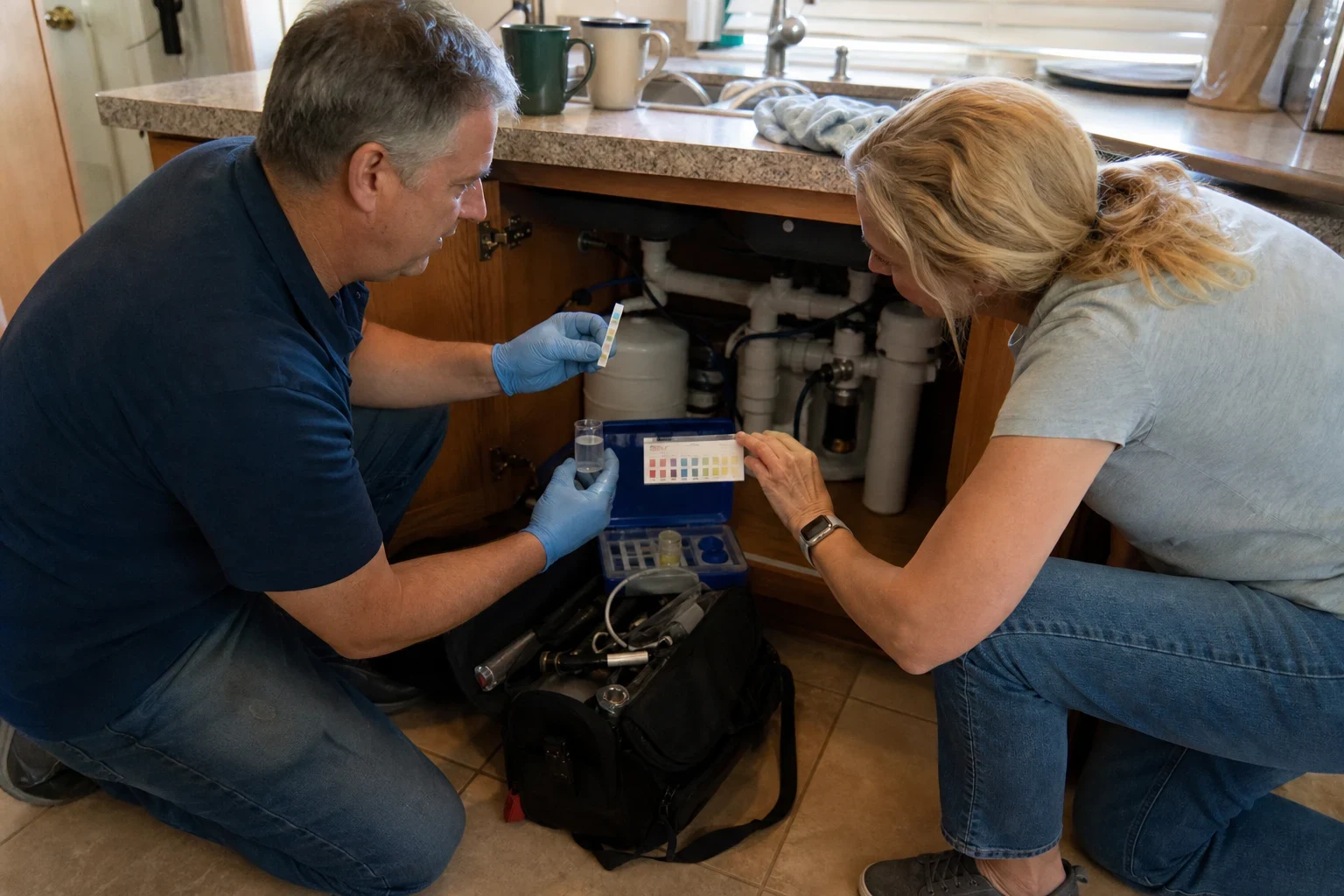
Hard water carries dissolved calcium and magnesium. When there's a lot of it, you see chalky rings around the tap, a dull film on drinking glasses and minerals settling at the bottom of the water heater. When there's only a little, it rarely causes trouble. Measuring is the only way to know which group your home falls into, so every softener conversation with us begins with a hardness test at your tap.
Once we have the number, the same person who ran the test walks you through it, answers your questions and, if a softener makes sense, handles the sizing, the install day and the cleanup. You won't be handed off to a salesperson and then a separate crew.
Sometimes the test shows the real issue is something else, like chlorine taste or rusty staining. In those cases we'll talk about whole-house carbon filtration or iron and sediment filtration instead of selling you equipment you don't need.
What a softener job with us includes
- A hardness reading first
- Before any equipment comes up, we read the mineral level in your water, reported in grains per gallon, and look for dissolved iron, since iron changes how a softener needs to be configured. You watch the reading happen and see the number yourself.
- Sizing to your household
- Grain capacity is matched to your hardness reading and your family's daily water use. Too small a unit cycles constantly and burns through salt. Too large a unit means paying for capacity you'll never use.
- Placement and plumbing
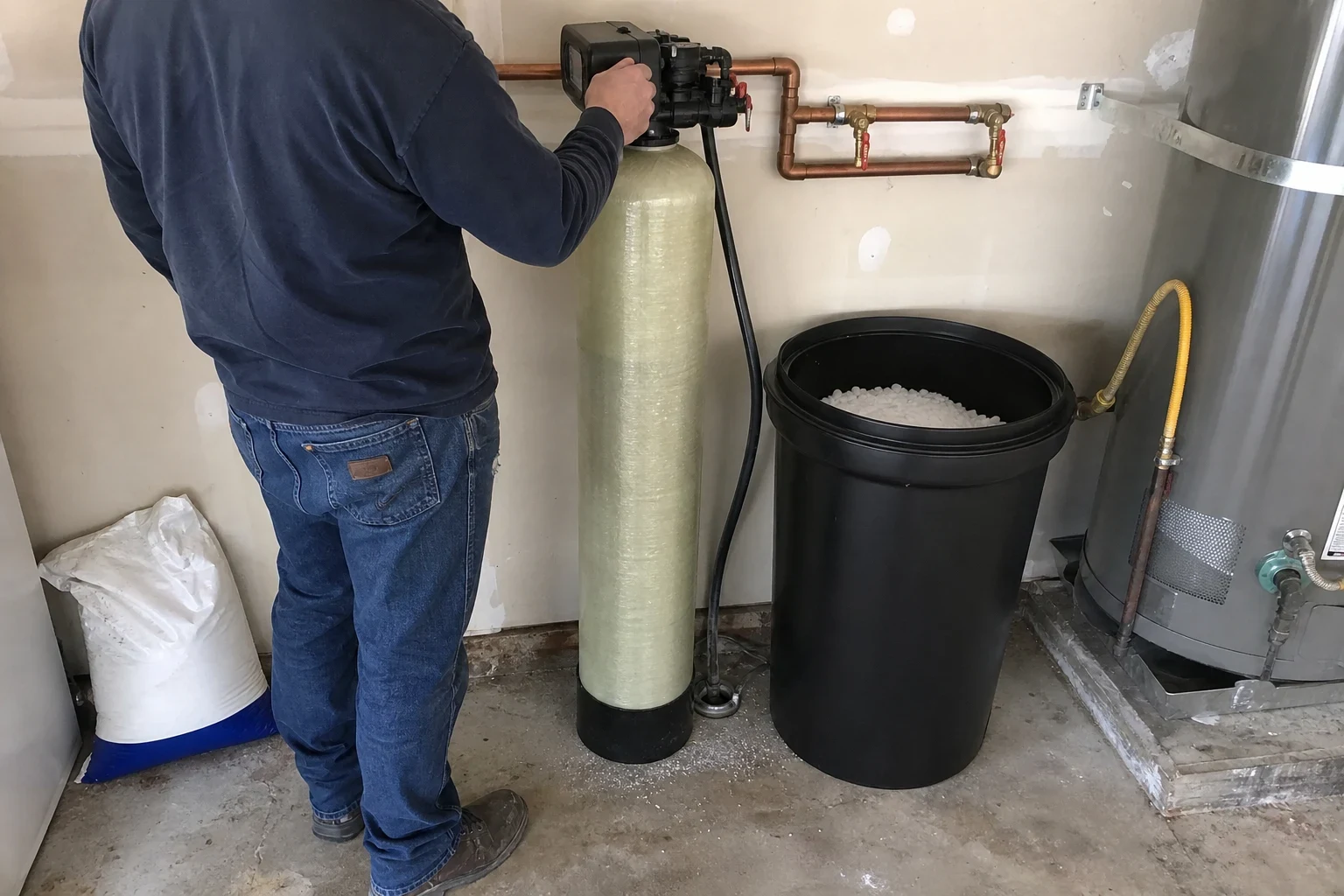
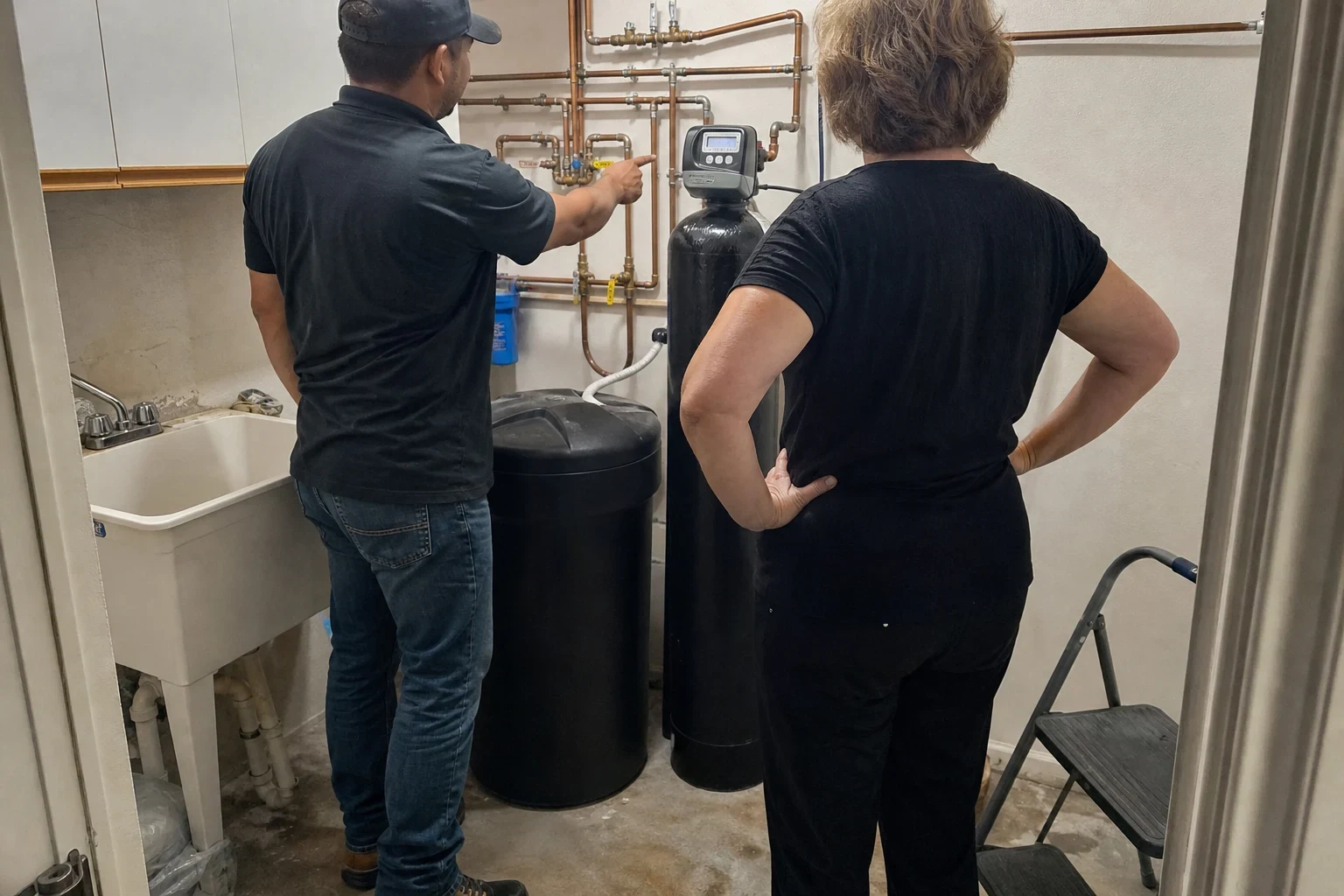
- We install the softener where it can tie into your main line, usually near where water enters the house or in the garage. A bypass valve goes in so the unit can be isolated for service without shutting off your water.
- Drain line and brine tank setup
- The regeneration drain is run with a proper air gap, and the brine tank is filled and set. We typically leave outdoor hose bibs on unsoftened water so you aren't softening what goes on the lawn.
- Settings and a walkthrough
- We program the control valve for your hardness and usage, then show you how to check salt, use the bypass and read the display. Before we leave, the work area is cleaned up.
When it makes sense to check your hardness
Chalky rings around the tap
A pale, rough layer that builds up where water dries on faucets, shower heads and the dishwasher door is mineral scale. It's the most common reason people call us about softening.
Spotty dishes and cloudy glass
If glasses come out of the dishwasher filmed or spotted even with rinse aid, hardness may be the cause.
Soap that won't lather
Hard water reacts with soap, so shampoo and dish soap feel weak and leave a sticky residue on skin and tubs.
Crackling sounds while the heater runs
Minerals can settle into a crust on the floor of a tank heater, and water heating through that crust makes a knocking or crackling sound. The buildup also means the burner or element has to run longer to give you the same hot shower.
Short-lived appliances or fixtures
Cartridges, aerators and valves clogging with grit sooner than they should is worth a look, though sediment can cause it too. The test sorts out which.
How it works from first call to cleanup
- 1
A conversation by phone
You tell us what you're seeing and what worries you. We set a time to come out and test.
- 2
Testing and an honest read
We test at your tap and go over the results with you right there. If hardness is low, we say so and you're done, with no pressure.
- 3
A written estimate
If a softener fits, you get a line-item estimate covering the unit, the plumbing work and any extras, so nothing comes as a surprise later.
- 4
Install day
We protect the floor where we work, shut off your water for the plumbing tie-in, and restore it as soon as the connections are tight. Most installs are finished within a day.
- 5
Final check and cleanup
We run a regeneration cycle, check for leaks, show you the controls and clean up. Your questions afterward come back to the same person.
What sets the price of a softener
Softeners don't come with one fixed price, since water and plumbing vary from house to house. After the test, we hand you a written estimate that shows what each dollar covers and the reason for it.
- Hardness reading and household size
- How hard your tap water tests and how many people share the house decide the grain capacity you need. Higher capacity means a larger resin tank.
- Metered or timed valve
- A metered valve regenerates only when your actual water use calls for it, which saves salt over the years. A basic timed valve costs less at the start.
- How easy the plumbing is to reach
- If your home already has a softener loop, the install is simple. New lines or a longer drain run add labor.
- Iron or other findings
- When the test shows iron or sediment, the softener may need a prefilter or a different setup to keep the resin protected.
Common softener questions
Something not covered here? (972) 597-4653
Will you push a softener on me if I don't need it?
No, and that's why the test comes first. If your hardness reads low, we'll say a softener isn't worth the money and tell you what might help instead, if anything.
How much salt does a softener use?
That comes down to your hardness, how much water you use and how the valve is set. A correctly sized unit with a metered valve goes through clearly less salt than one that regenerates on a set timer. We'll show you how to check the brine tank and when to top it off.
Can I drink softened water?
A softener trades hardness minerals for a little sodium. Most people drink it without a second thought, but if you're limiting sodium, an under-sink reverse osmosis system at the kitchen sink strips most of it from the water you drink and cook with.
Will a softener get rid of chlorine taste?
No. Softeners handle hardness and a bit of iron, not chlorine. For taste or odor, whole-house carbon filtration is the fix, and we can install both systems on the same visit.
How do I take care of a softener?
Keep the brine tank stocked with salt and have the unit checked from time to time so the valve and resin stay in good working order. Our filter replacement and maintenance service can handle that along with any filters in your home.
Find out if your home needs a softener
Let's measure your water before anyone talks about equipment. One call gets you a test, a straight answer and one person to work with from there.